Pages

Monday, March 5, 2012

Defending the Prospect Park West bike lane isn't cheap

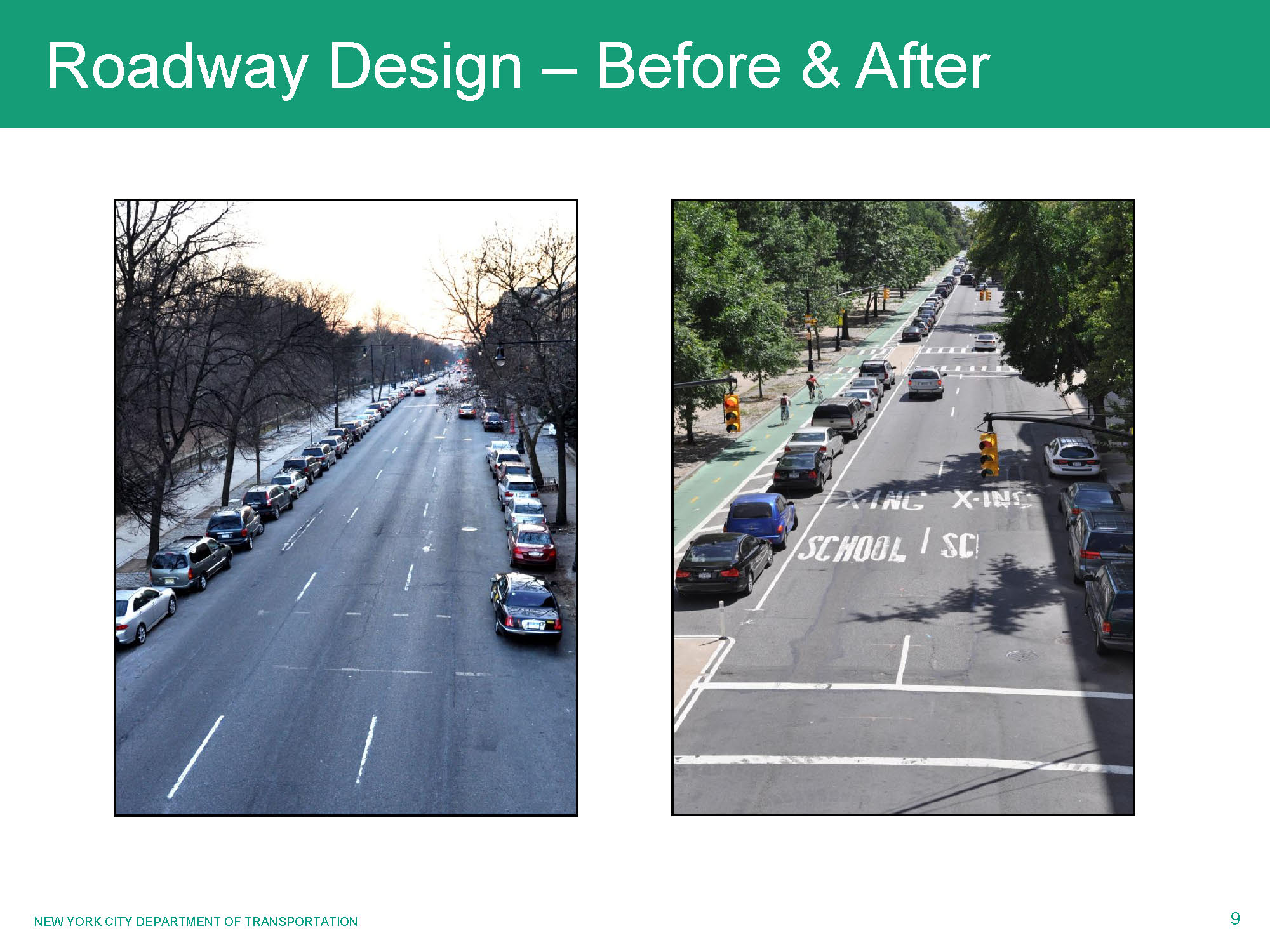
The article explains that the city is arguing weather the Prospect  Park's bike lane was a good idea or a bad one. The article says " the city has already spent $140,000 defending the prospect Park West bike lane- and that number is expected to increase after opponents of the path filed an appeal" by the Brooklyn Paper. On one side the lawsuit argued that the bike lane turned the peaceful street into a hazardous place for pedestrians t o walk by.  On the other hand people like Jim Walden, who was actually an opponent of the bike lane, said that the people " have a right to appeal"..."This is America"..."Get real".  Which means that the bike lane idea should be up to the people and/ or the citizens around Prospect Park.  People have gathered around the park saying that there is not enough space for the cars to park with the bike lanes.  Other say that the lanes give other advantages to to people without cars and there is just enough room for cars too.

I think this article has good and bad point in it, but it looks like people complain more than go for the idea.  I really do agree.  I think having a bike lane a t Prospect Park is a good idea and it gives many advantages to people.   I think that if its already there then just leave it there.  Also it is helping our environment, by telling people that there can be another way to travel besides by car.  Another thing is that I think that it is the peoples choice whether they like the bike lane there or not.  Something I wondered was: how far will they make the bike lane and does it go around the whole park?


Friday, February 10, 2012

This week in science #9


 This week in science I did many things.  One thing we did was dissect animals and we got new organisms to dissect.  We were given a mouse, frog, perch(type of fish), and a skate(a type of stingray). They all smelled pretty bad.  On the first day of dissection we picked an animal and given a paper that us instructions.  The instructions were to take pictures of the different sides of the skate, like the dorsal and ventral views. Then we were given white pieces of paper  to draw those views, and as groups of 2 each person got 1 side to draw.  After that we had to all label the different parts of the skate from David's blog, next we uploaded them to google docs.  The most horrible part came next and it make me nauseous through the whole day, dissection.  Me and my partner dissected the skate and took out what another instruction sheet told us to do, like the liver and digestive system, nasty.

This week in science I learned quite a few things.  The dissection we did was very interesting.  I learned things like bravery, I saw that pushing yourself to do something is not all that bad.  I didn't want to ever cut up an animal like I did yesterday.  I learned how thick a stingrays skin actually is.  I learned how terrible preserved water and animals smell.  We also learned that there are specific ways to holding dissecting tools so you don't hurt your self.  I learned many animal facts, i didn't know skates have many rows of teeth, and pointy spikes all over their body.

In my group, that was spilt into two partners each organism, one group had a perch and one had a skate. In my case I had a skate (which means the other group had the perch). I think that there were actually many things similar about these organisms. For example, both animals were marine animals. Also they both had gills to help them breath under the water. Their skin was also pretty thick and a bit hard to cut with the scalpel. They both had a tail and fins that help them float and manuvure through the water. There were a lot more differences too. The skate was much bigger. The perch's eyes were kinda on either side of its head while the skate had its eyes on the dorsal side of its body, with no eyelids!! The perch's facial structures and part were all in the front of its body, while the skate had its gills, nostrils, and mouth on the bottom where it's belly is. Also the skate had spikes all over its body, mostly on its head, tail and fins. When finding the gender of the animal the skate has somethings called clasps, they hung on each side next to the tail. If they had them that would mean its a male, if not, it is a female. I thought that the marine animals would be the easiest, they kinda were except they were the smelliest.

Friday, February 3, 2012

TWIS #8


This week in science we got the chance to dissect a couple of preserved organisms.  My group had to dissect a giant grasshopper, I didn't like it.  It smelled horrible and made me nauseous.  We looked and took pictures of the grasshopper's Dorsal view, Ventral view, mouth parts, and side view.  In my picture i drew all of these and in the second picture i dissected it and pinned it down  to show its insides. 
Then we uploaded these same pictures and more to google docs.

This week in science I learned many things. One thing I learned was how disgusting it is inside of a bug. I never knew what it looked like in a bug, I couldn't really tell what was what in the grasshopper. I also learned that grasshoppers have weird pads on there feet that to me kinda looked like palms. Also I noticed that they have spikes on their legs, probably for protection. I saw that grasshoppers really do look like how they showed them to look like in the movie "A Bugs Life".

Tuesday, January 31, 2012

This week in science #7


This month we started a new project about biomes.   A biome is a large part of earth that consists of different plants, animals, climate, their geology, and location on earth (by latitude and longitude) for each place.  With knowing this we started a project where we got into groups, of at most 4, and we each picked a biome or place on earth that we can study and research.  We had to find out the climate, location, vegetation, and landforms.  that's only thing first part.  My groups did a specific tropical island instead of a biome like the other groups, we did an called Christmas Island.  On another day David and Jamie gave us each group a letter and since our climate was tropical and warm, our letter said that our climate has gone 100,000 years into the future and the island was covered in snow.  We had to make a slide showing the difference in our island,  we had to each pick an animal on the island that has newly adapted to the cold winter wonderland like island, and give it new features that will help it survive.  When we were done with the slides we wrote side note called Speaker Notes that helped us when narrating our slides.  Then we used something called ScreenCast.

This month we also learned many things.  For example we learned about many biomes and what biomes are.  Also i learned more about an island that i've heard about but never really researched.  I learned where it is located, what life it inhabits, and much more.  One main focus animal i had to research was the Red Crab.  The island is filled with the crabs especially because of their year migration to the ocean.  I is said that all is seen is a big red blanket covering the whole island.  I also learned how much a tropical island is changed by changing its climate, it affects the entire island and all in it.  Another thing was that i found out that Christmas Island isn't all about Christmas.  I learned many computer tricks and new things to do on the computer, like speaker notes and how to use them.  Also I now know what a Screen Cast is and how cool it is when using it.  I really liked doing this project and I hope we do this again.

Wednesday, January 18, 2012

Cricket Investigation


Background Research:
Crickets have many necessities.  One of their needs are that since they are omnivores and scavengers 


Question:
Do crickets prefer fruits or vegetables?


Hypothesis:
If on one side of the tank we put a fruit and on the other side a vegetable, then the crickets will prefer the fruit better,  because the fruit decays faster and is moister.   


Experimental Setup:


This is an image of the cricket tank showing the fruit (apples) on the left side and vegetables (celery), and cricket on the right side.


Data Table:
 I took 4 trails of method 2.  Method 2 shows there  precise movement from either side of the tank.


Conclusion:
During the investigation, I notice that the crickets preferred both the fruit and vegetables equally.  The cricket mostly spent its time hopping around, but it spend 50% of its time on either foods.  I took 4 trials in two of the trials the cricket hopped around ignoring the food.  For the other two trials the cricket either ate apples or ate celery equally.  So this proves that the cricket did not only prefer apples over celery.  


Friday, December 9, 2011

This Week in Science #6

This week in science we did many things.  On Monday we talked about things organisms need to survive like ourselves, and we were told that we would be observing crickets for the week.  David told us to search up 10 things crickets need to survive.  Also we wrote questions about what crickets would prefer in there tanks.  On Wednesday we talked about the cricket's behavior toward different things put in their tank.  Each group of 4 received 2  tanks of crickets.  The tanks were divided in half and half of the tank had damp paper towels and the other half had dry paper towels.  We were also given a mission challenge to help us record the crickets different behaviors toward the paper towels.  We timed ourselves while recording their movement, I thought it was really interesting how they responded.  Thursday we had another mission challenge and had to classify different jelly beans into different groups using a Dichotomous Key.  Two people from my group were not here so it was only 2 people in the group, it was still fun.

This week in science we learned many things.  For example I learned many facts about crickets like: crickets are omnivores and scavengers who feed on organic materials, they need to communicate with each other  by sound, scent, and touch, they eat fruit, nectar, small insects, and leaves, and also that they need warmth.  Those facts interested me the most.  I also learned that crickets like a habitat that is a little damp and warm.  Another thing is that, I learned before about a Dichotomous Key but i didn't remember how to use one,  I learned how to use and make to forms of a Dichotomous Key.  The final thing I learned was that Jelly Belly jelly beans have some really odd names.

Friday, December 2, 2011

This Week in Science #5

 This week in science we did many things.  For example, on Monday we worked on our rocket mission challenges.  We worked on improving and finishing our conclusions.  On Wednesday we work on our rocket mission challenges some more, and we were set up in groups based on the amount of work we got done.  One group was sent out of the room, while they were out my science teacher David decided that if we put away our laptops we could watch the animals.  By animals he meant the pet tarantula named Ocho and the crickets we were going to be experimenting with the next day.  On Thursday we started a next unit in science class about animal behavior.  For our warm-up we watched a video about a rare bird's reaction/behavior toward 2 men observing it in the wild.  Next we all went on our laptops and searched for videos to watch and share with the class, I chose one of a mimic octopus and a frog saving another frog from a snake.  Then we got into groups of 4 and each 2 people in the group got a small container like cage with about 3 to 6 crickets in them.  We then drew the crickets from different angles and made a T-chart  about things we observed and things we wonder about the crickets.

This week in science we also learned many things.  One thing I learned was how to take a snap-shot of a picture or piece of writing on Google-Docs.  Another thing I learned was that writing a conclusion to a rocket mission challenge is stressful.  I also learned that there is a rare bird in New Zealand called the Owl-Parrot and that there are currently only 90 of them left on earth.  I learned what crickets look like when the hop, and how they really look up close.  Crickets also respond to sound when I tapped my pen on the cage they would move their antennas.  Another thing I learned was that crickets make a lot of noise.